Impact of Radio Frequency Interference from future satellite mega constellations on the SKA Observatory
Swiss SKA Days, Neuchâtel, 01/09/2026
Nicolas Cerardi
With Emma Tolley, Federico di Vruno and Chris Finlay

We are not alone... on the radio spectrum !
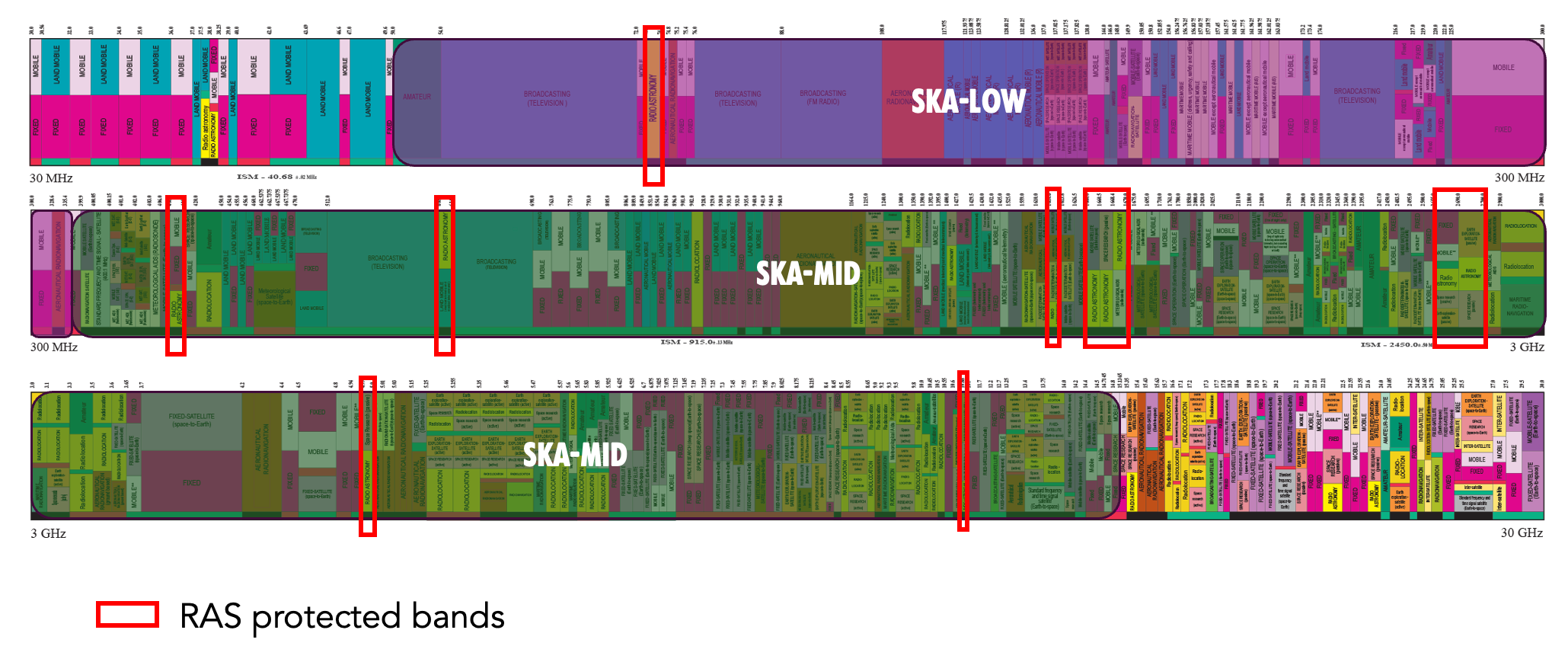
RFI from satellite constellations
- Intended emissions (in ITU-R allocated bands).
- Reflection from sunlight and terrestrial sources.
- Unintended Electromagnetic Radiation (UEMR).
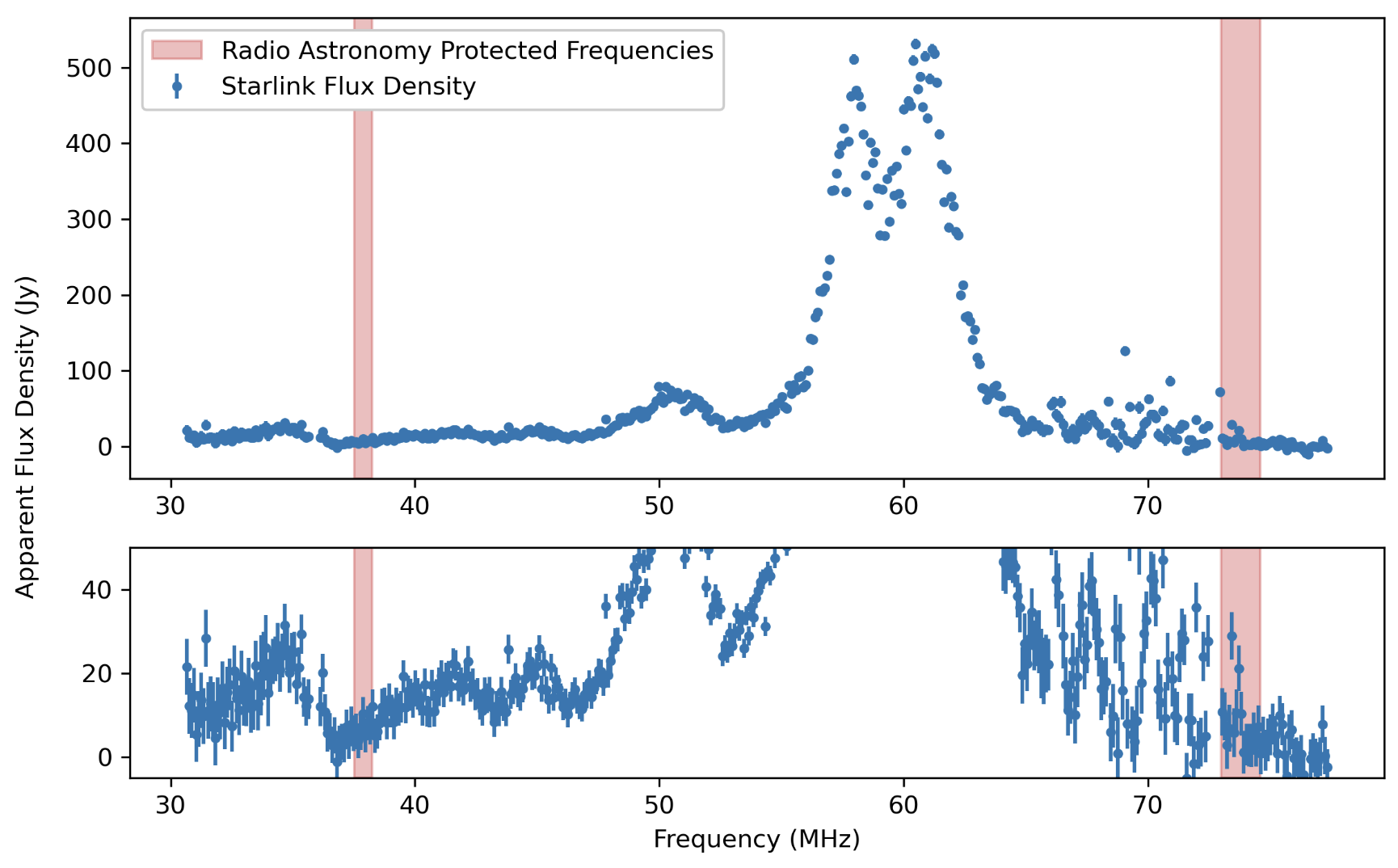
[Zhang+25] Bright UEMR continuum from Starlinks in the 30 - 78 MHz range.
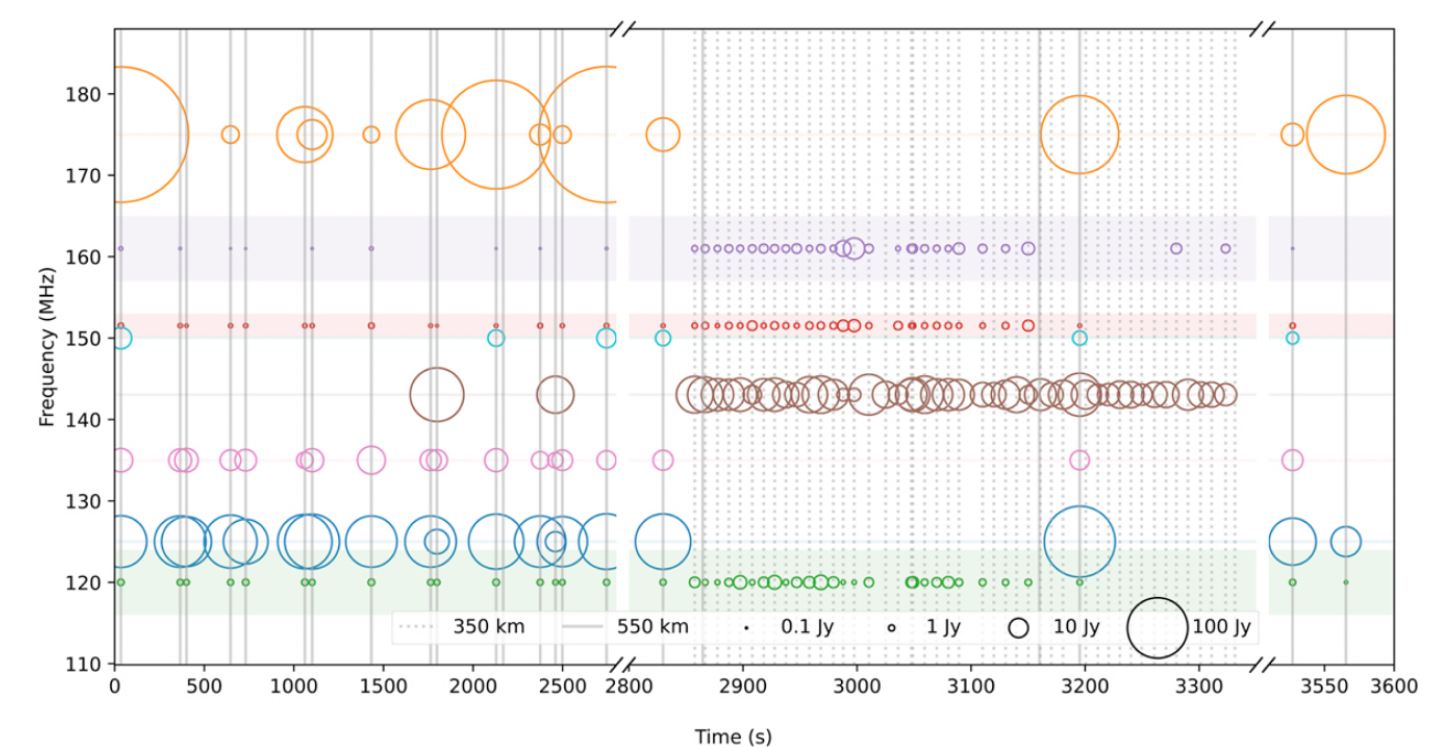
[Di Vruno+23] Both spectral lines and broad band features in the 110 - 190 MHz range.
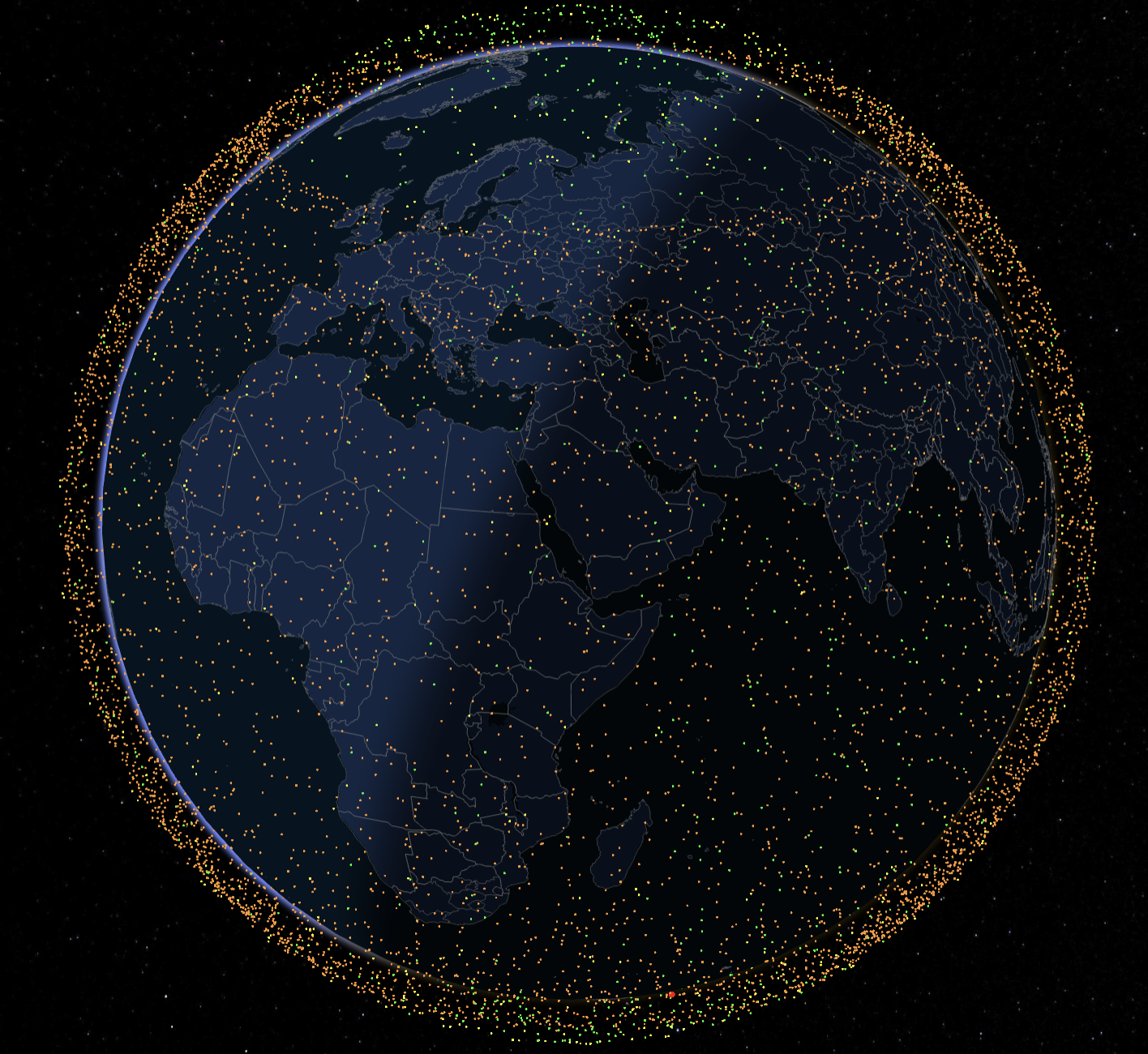
Starlinks in LEO now
| i [deg] | h [km] | n |
|---|---|---|
| 53.0 | 550 | 1584 |
| 53.2 | 540 | 1584 |
| 70.0 | 570 | 720 |
| 97.6 | 560 | 520 |
| 53.0 | 340 | 5280 |
| 46.0 | 345 | 5280 |
| 38.0 | 350 | 5280 |
| 96.9 | 360 | 3600 |
| 53.0 | 525 | 3360 |
| 43.0 | 530 | 3360 |
| 33.0 | 535 | 3360 |
| 148.0 | 604 | 144 |
| 115.7 | 614 | 324 |
Can we forecast the future observing conditions of the SKAO?
In 5-10 years
| Constellation | $ N_{\rm sat} $ |
|---|---|
| Starlink | 35000 |
| Oneweb | 720 |
| GuoWang | 13000 |
| QianFan | 1200 |
| Leo | 3000 |
- About 50 000 satellite trajectories to simulate...
- Instead, we can model the density of satellite in the sky with an analytical model from [Bassa, Hainaut & Galadi-Enriquez, 2022].
- We adapted this model and applied it to the SKAO in [Cerardi, Tolley, di Vruno, 2026].
- So far, a geometrical prediction only (no forecast of the received power).
Principle of the analytical modelling
Single satellite orbit
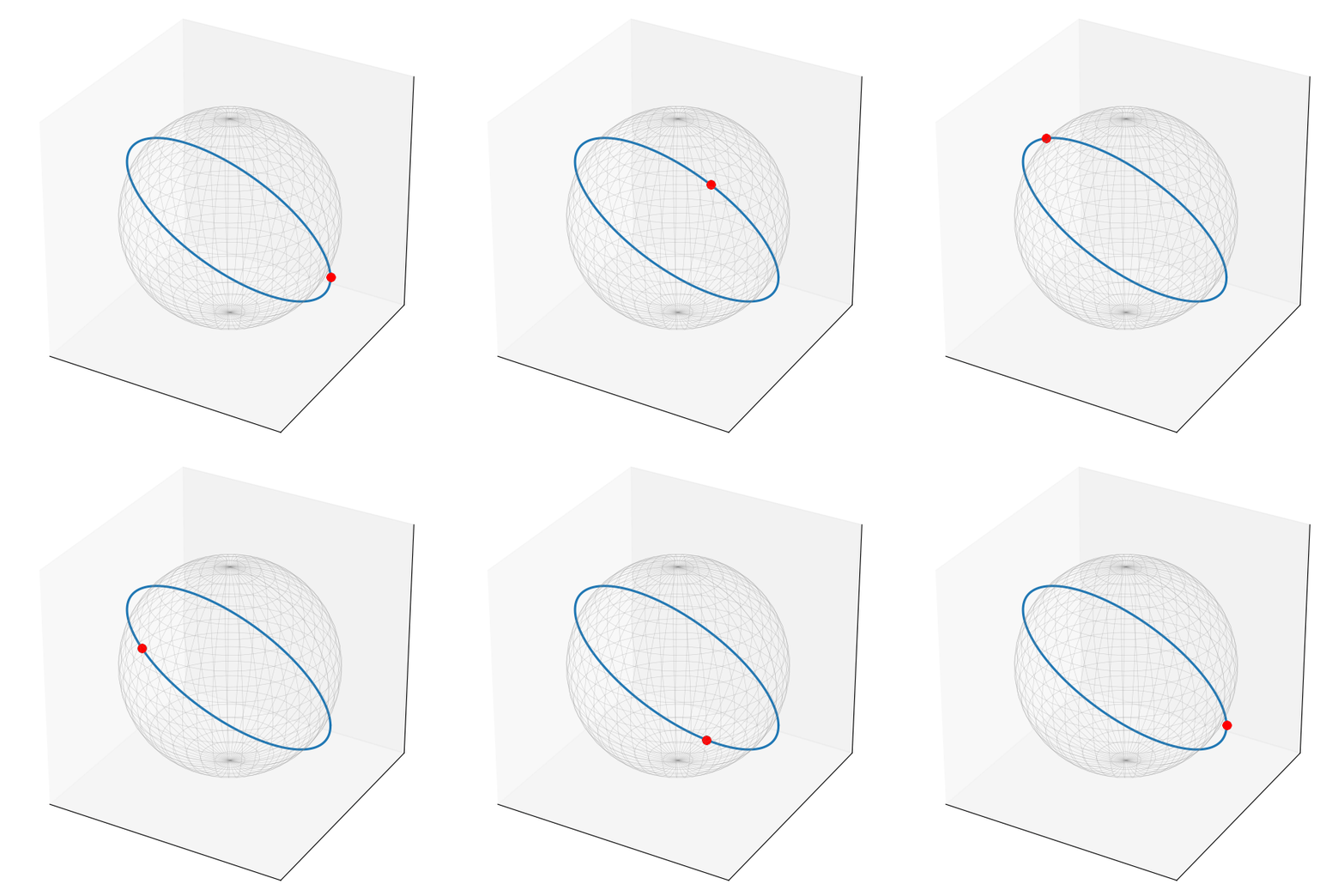
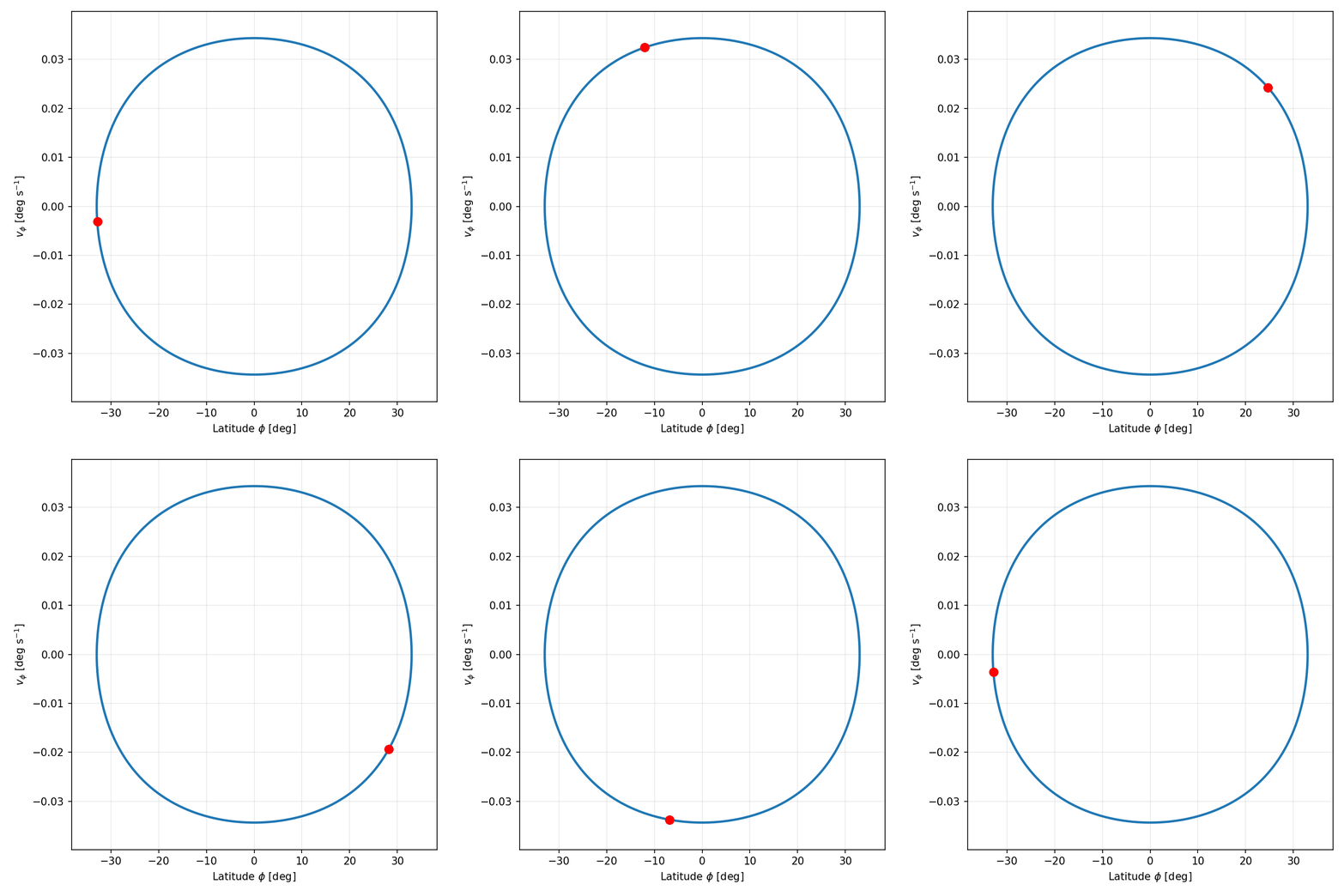
Phase space trajectory
Probability density
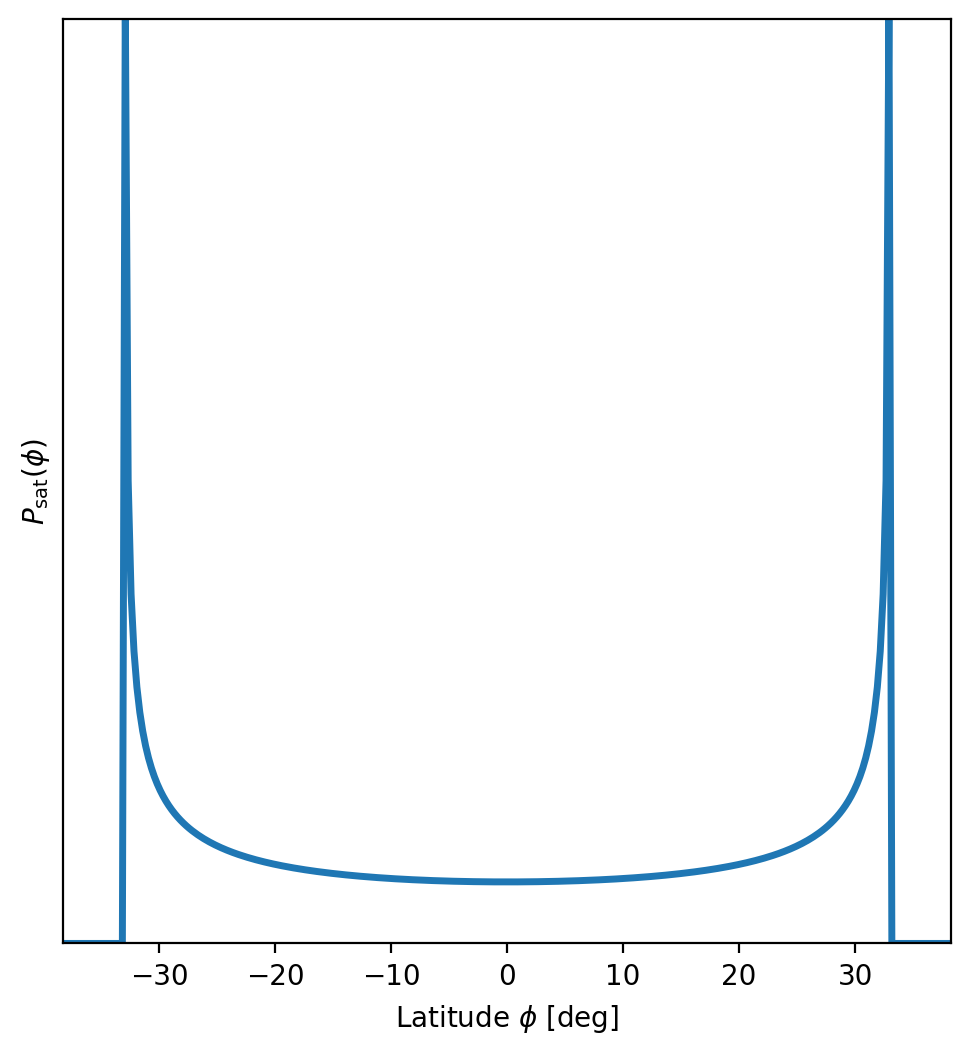
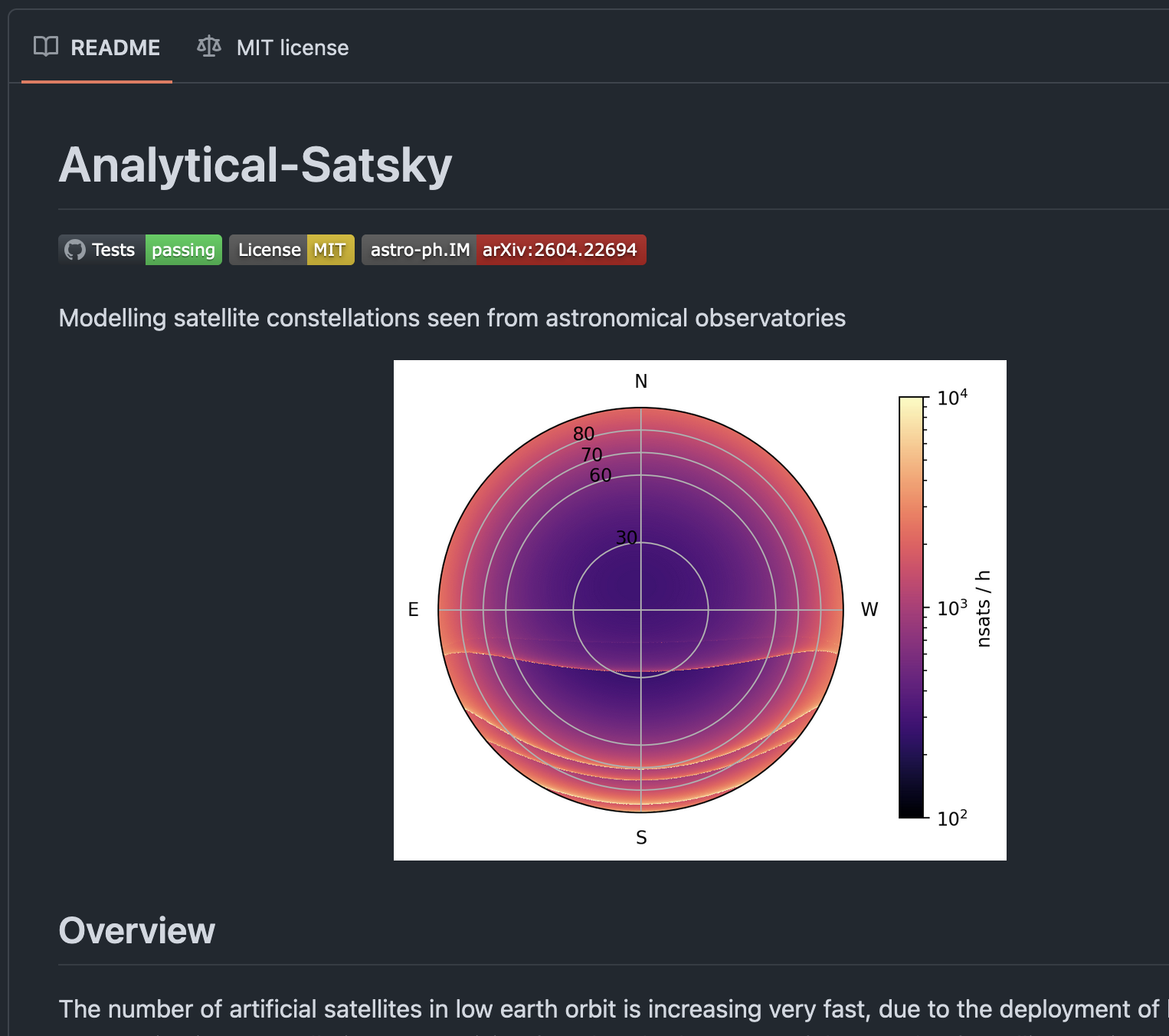
- Sum up static probability densities of each shell rather than simulating individual satellite trajectories.
Forecasting the satellite occupancy in SKAO observations
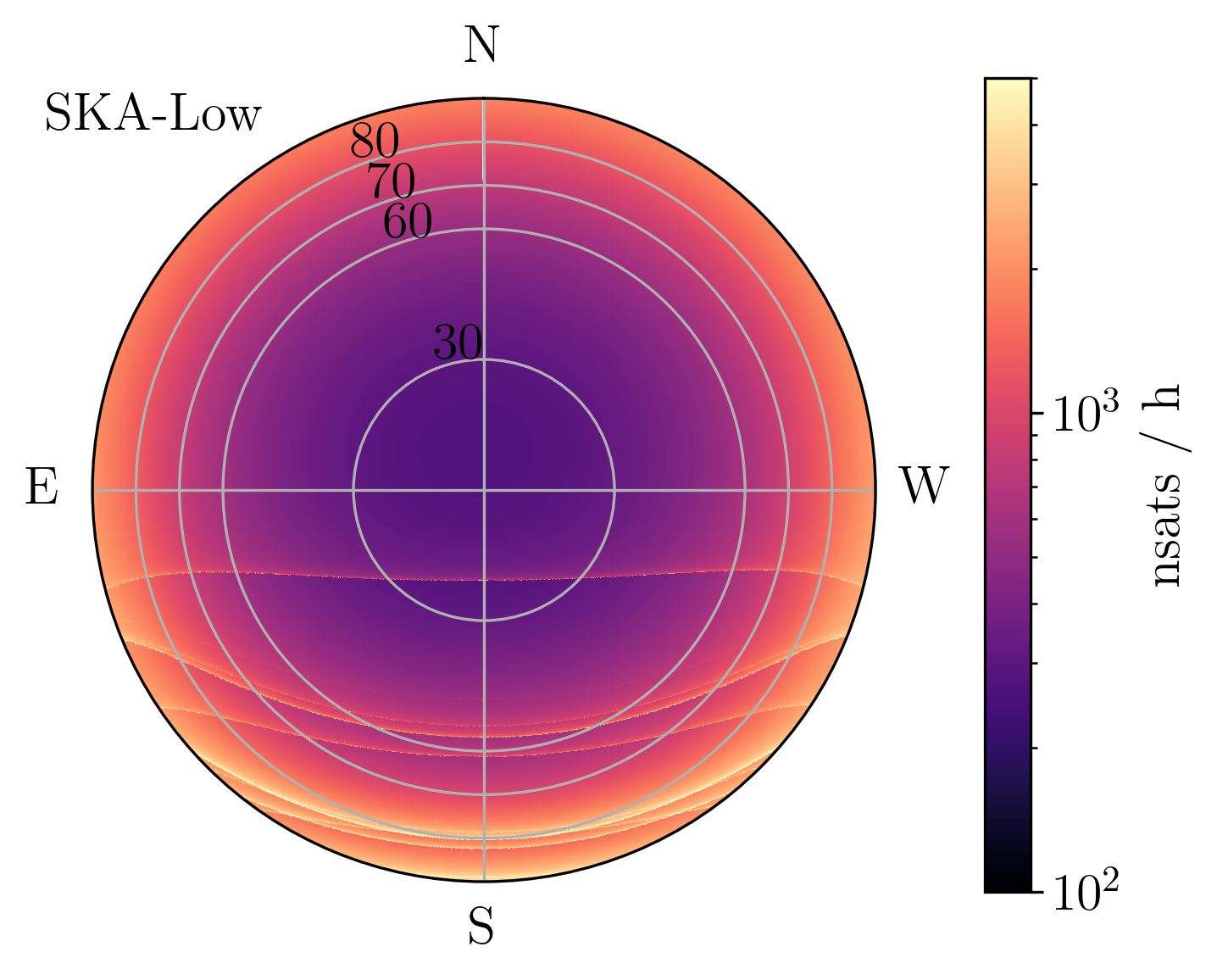
- At its latitude, SKA-Low is covered by most orbital shells.
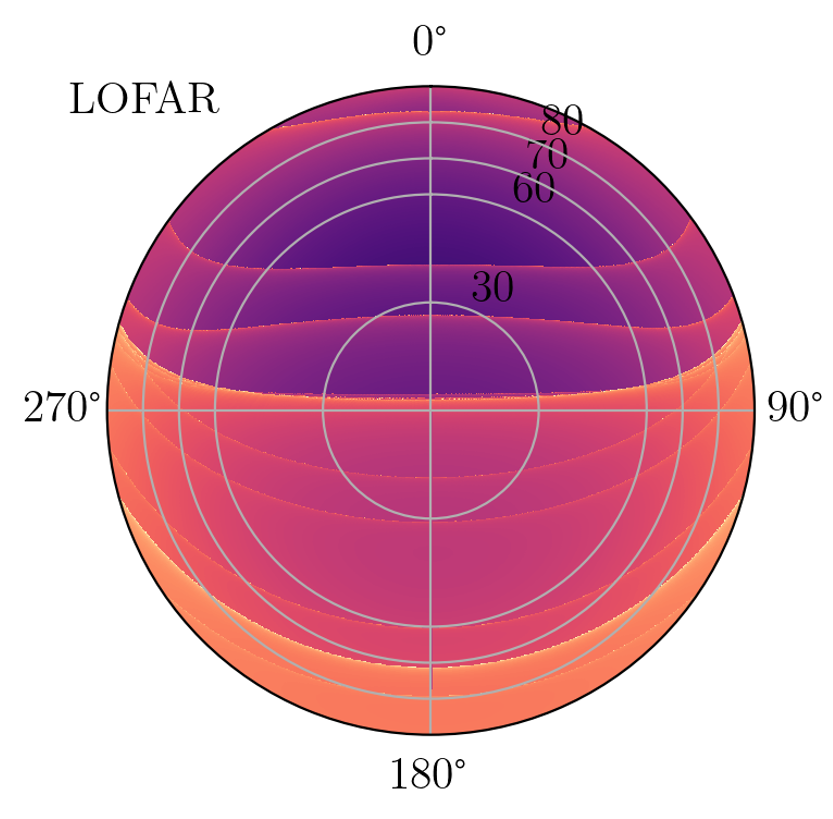
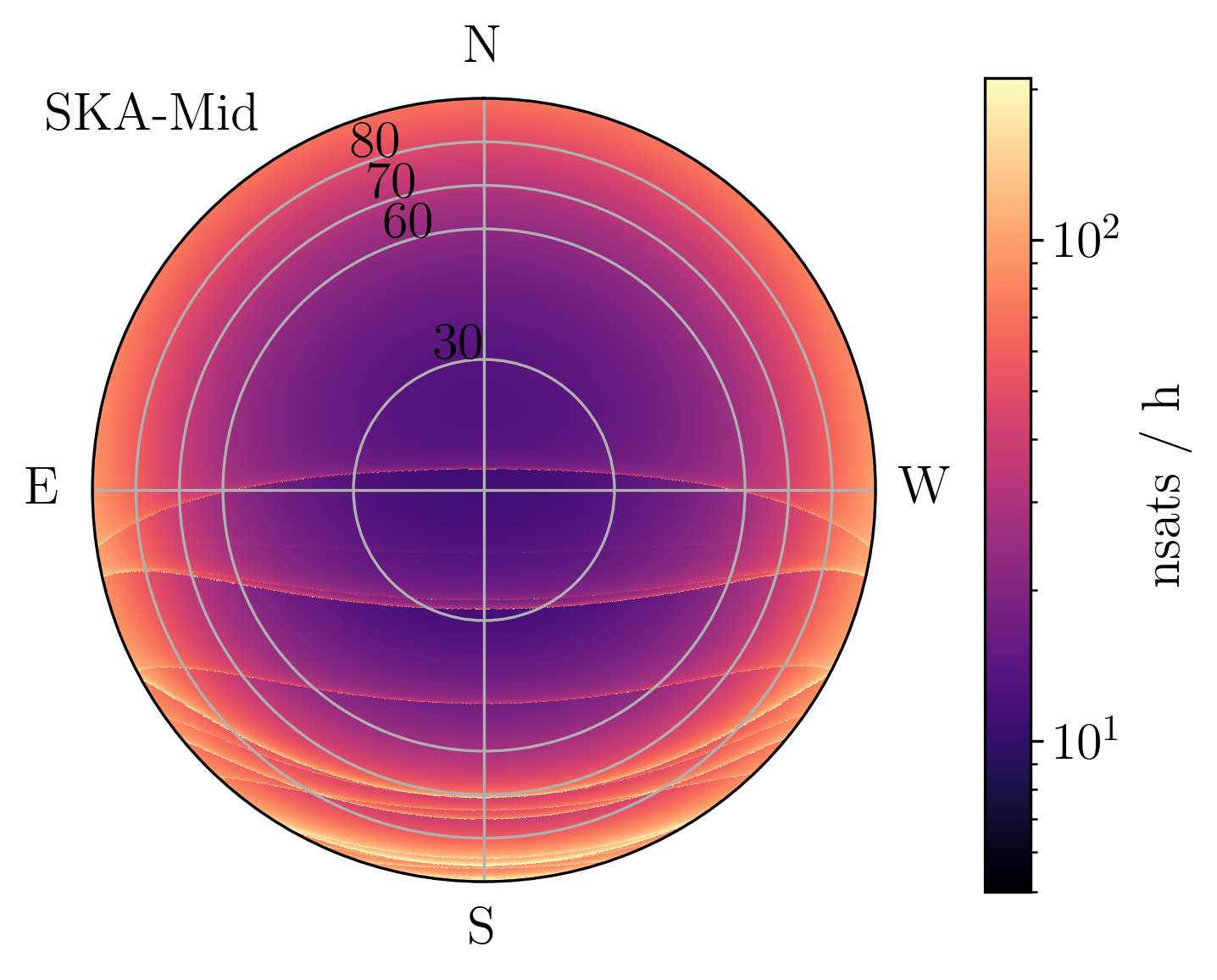
The exposition of the SKA-Low to mega constellations
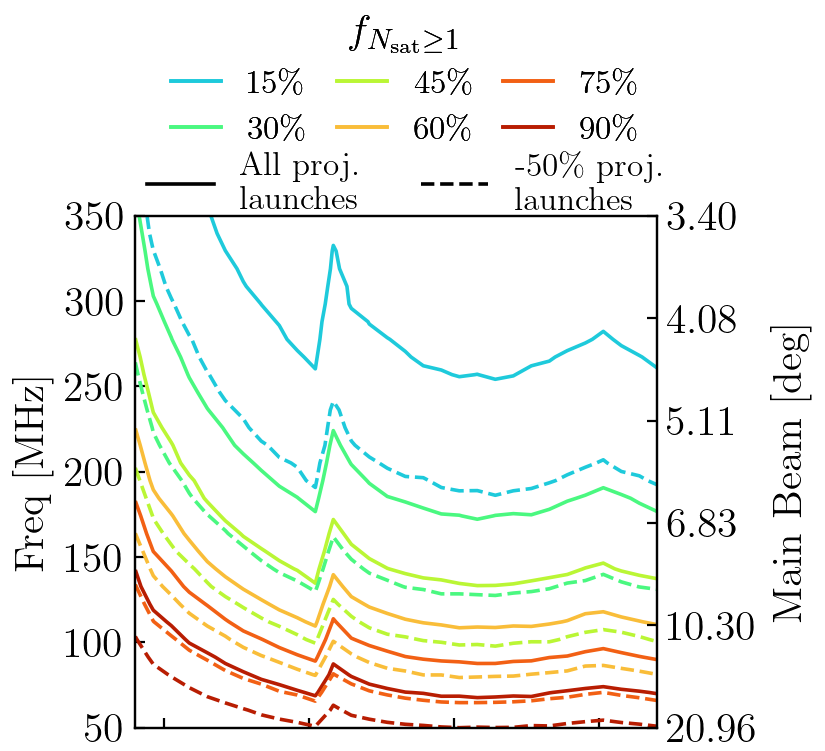
- Significantly exposed to satellites at all frequencies, up to 100% below 100 MHz.
- Flagging will not be a viable mitigation, other techniques must be developed, e.g. RFI subtraction (see Chris Finlay's Tabascal).
- More predictions for SKA-Low and Mid in [Cerardi, Tolley, di Vruno, 2026].
Code release
Analytical-Satsky
- Public repo: github.com/nicolas-cerardi/Analytical-Satsky.
- v1: simple model as in [Bassa et al. 2022, Cerardi et al. 2026]. Allows fast reproduction of the paper results.
- v2 (in progress): adapted for large FoVs, and satellite sampling.
- Users and feedback welcome!
Alright, but occupancy does not necessarily mean interference...
Predicting the RFI impact on the power spectrum
What would be the impact of undetected UEMR on an Epoch of Reionization experiment with SKA-Low?
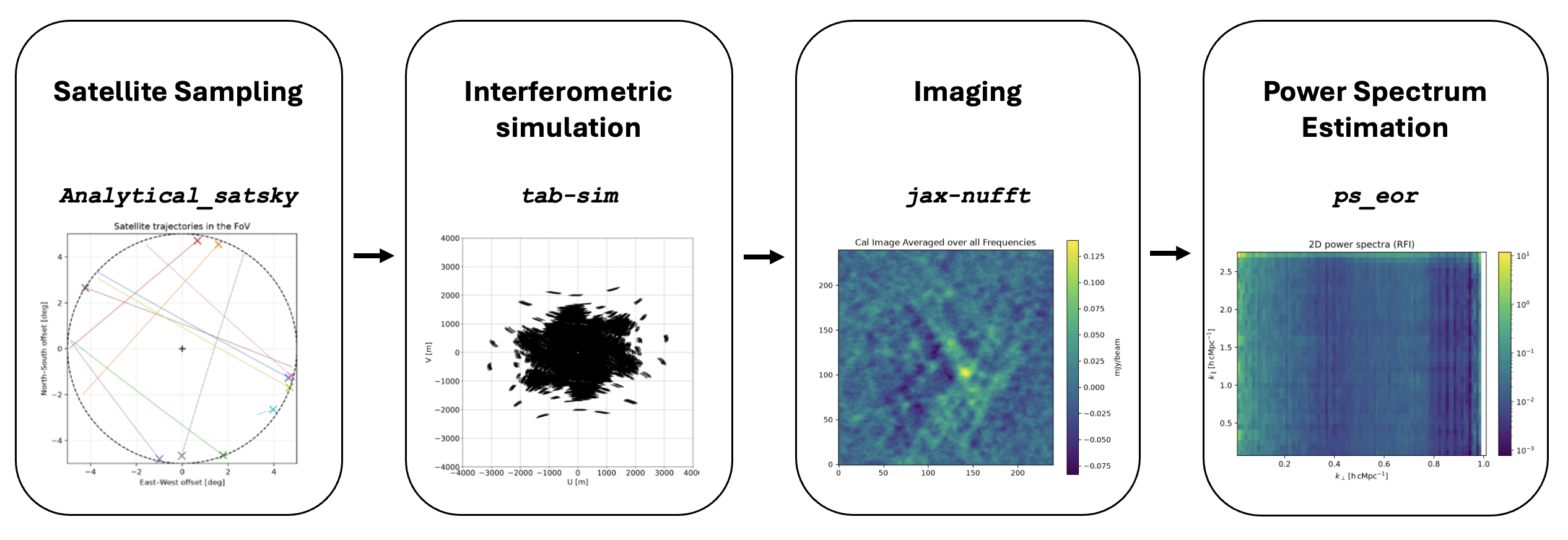
[Cerardi+ in prep.]
Sampling the (future) density of satellites
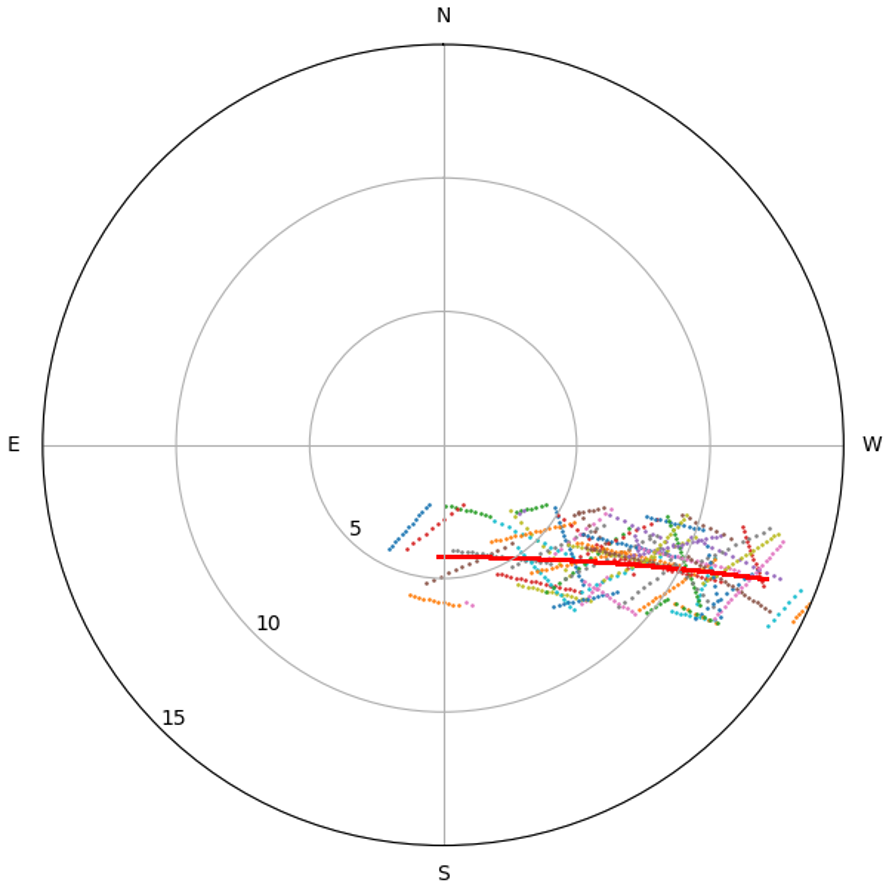
- Use the analytical density to spawn satellites at the FoV edges.
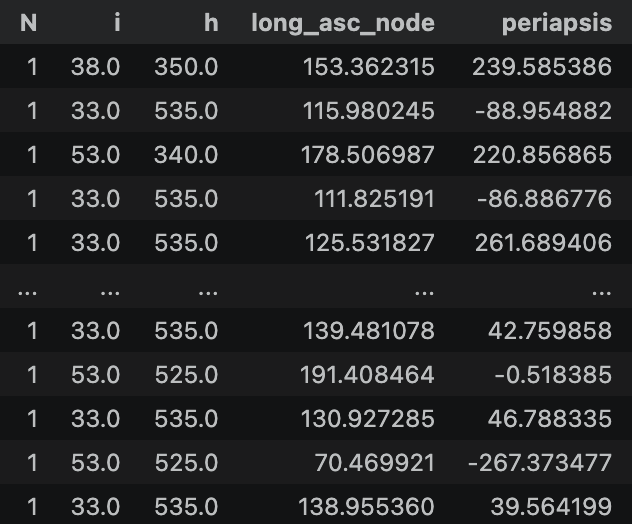
- Generate a catalogue of fake satellites with realistic trajectories.
Spectral properties of the satellite sample
[Di Vruno+23]
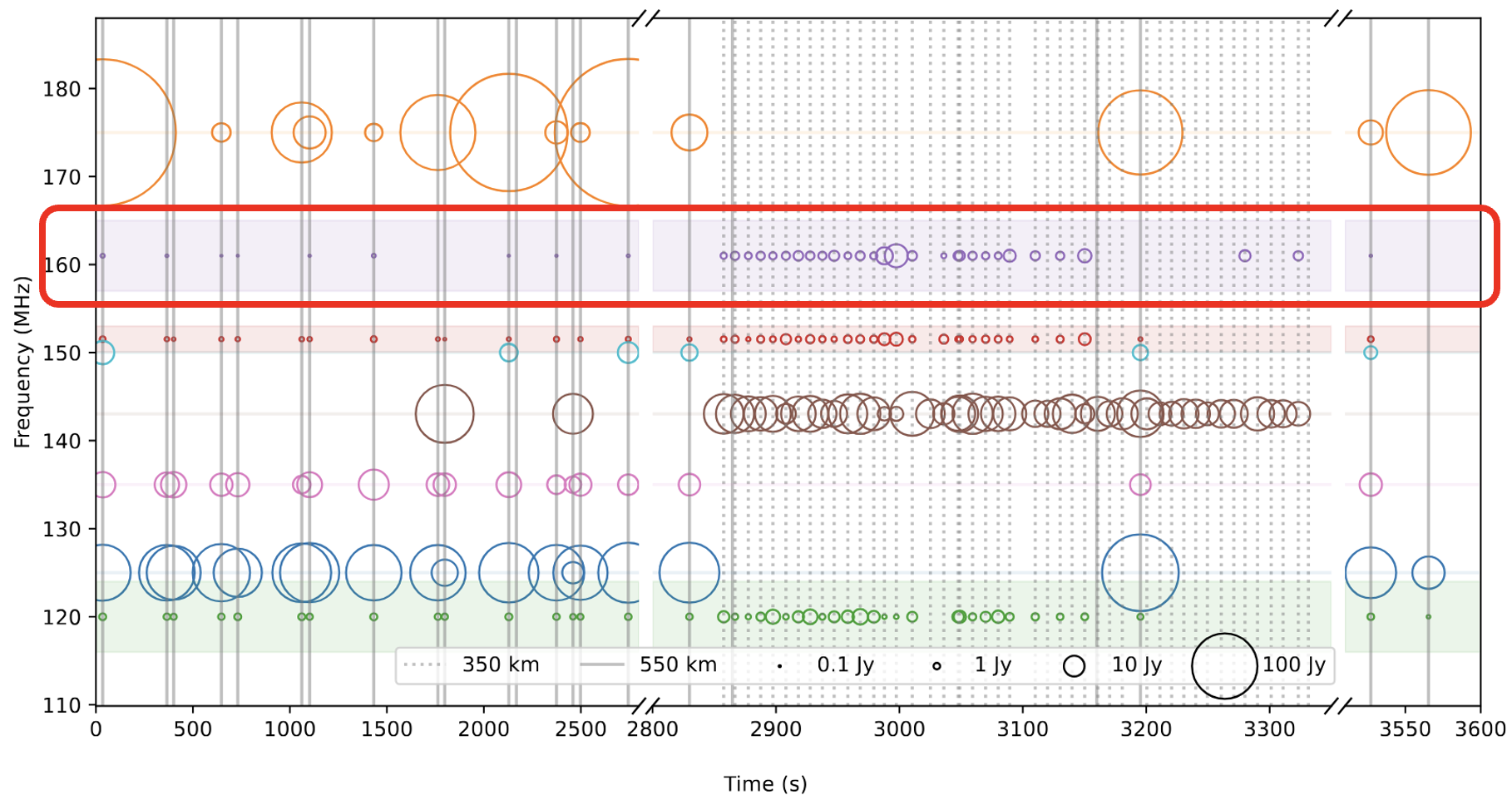
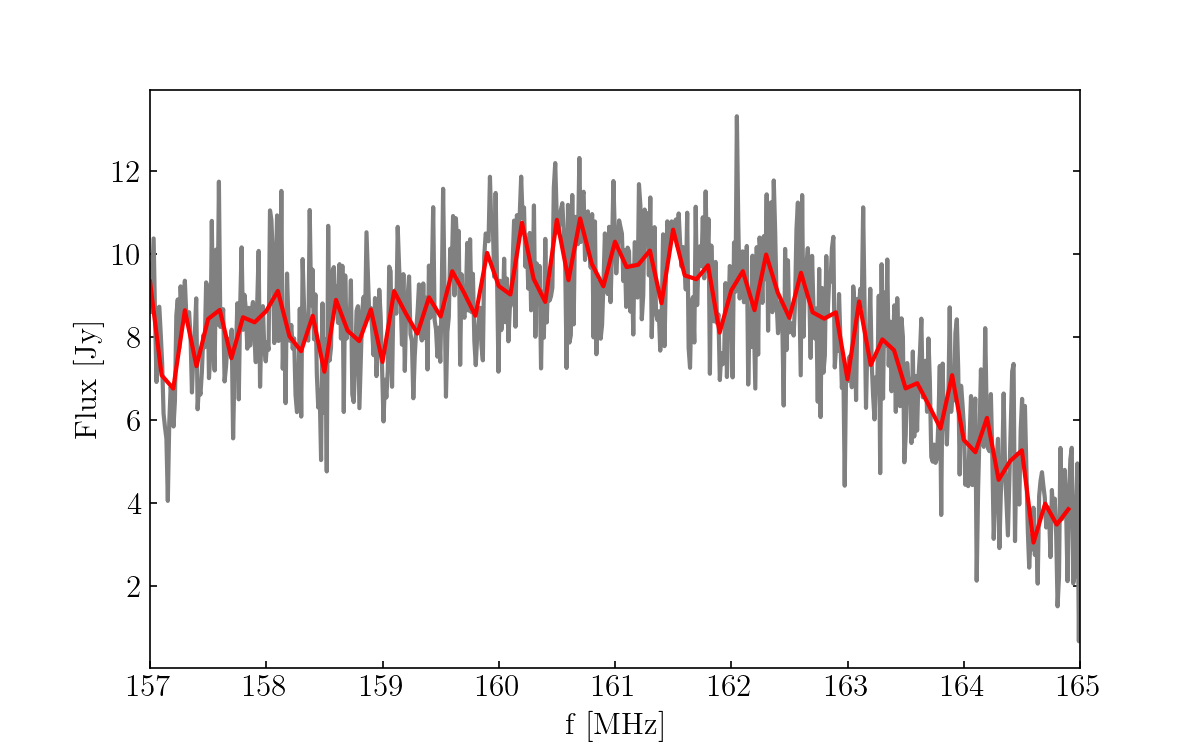
- Focus on the 157 - 165 MHz band, 100 kHz resolution.
Power spectrum of the RFI component
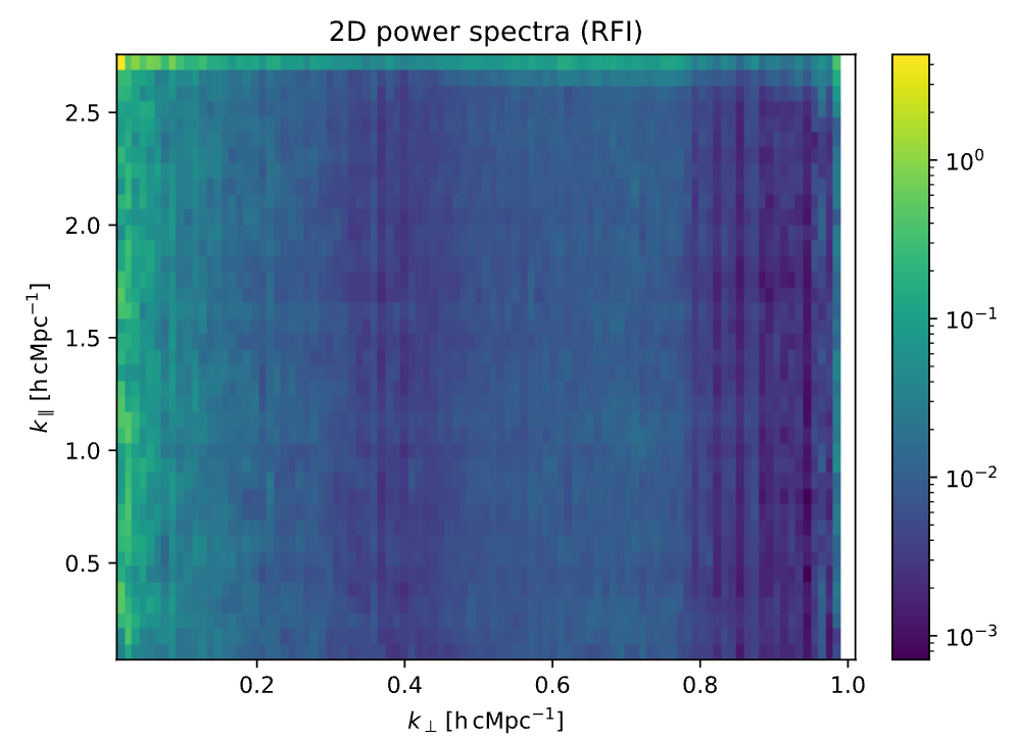
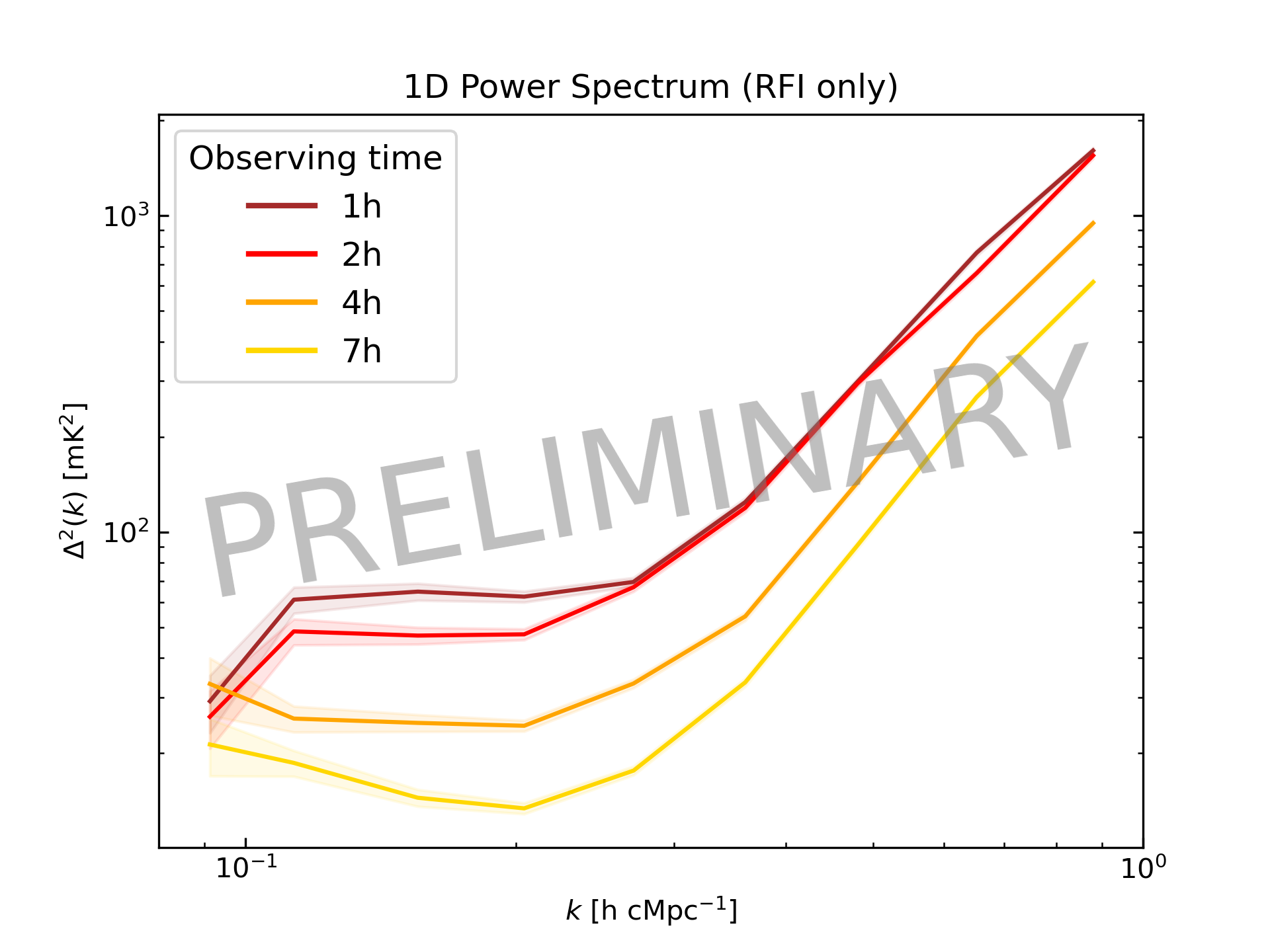
- Excess power located at small $ k_{\perp} $ and all $ k_{\parallel} $.
- Strong line at high $ k_{\parallel} $, possibly from the 200kHz oscillation.
- RFI power plateaus at low $ k $.
- Overall RFI power decreases with longer observation.
Conclusions and future work
Take aways
Forecasts of the SKAO RFI environment with analytical modelling of satellite constellations


- Prediction of the number/rate of satellites crossing the MB. Up to 100% at low frequencies.
- Estimation of the power spectrum contribution from faint UEMR. Strongest RFI power is found near the EoR window, but decreases with observing time.
- Simulations for longer exposures and diverse spectral features.
- Comparison with noise power.